New online store launch! 🎉


Are Merino Wool Clothes Really Expensive?

Let’s look beyond the price tag
“When I’m rich, I’ll buy merino.” A man said this in our shop while looking for a simple T-shirt. He smiled, left without buying one, and gave us something to think about: perhaps the merino wool cost per wear tells us more than the price shown on the label.
His comment reflects the way many of us judge clothes. We see the price on the label and decide within seconds whether an item is worth it.
But the real cost of a garment becomes clearer later: after it has been worn again and again, washed many times and still looks good; when it becomes the piece you pack for a trip, wear to work or choose for your child as a comfortable base layer.
Why does merino wool cost more?
Merino wool cannot be produced quickly in a factory. It grows naturally on merino sheep, and that takes time.
The sheep grow their fleece over several months. The wool is then shorn, cleaned, processed and spun into yarn. The yarn is made into fabric, which is later cut, sewn and checked before it becomes a finished garment.
Compared with many synthetic materials, the journey from fibre to clothing is longer. The price reflects not only the raw material, but also the time, skilled work, processing and quality control involved.
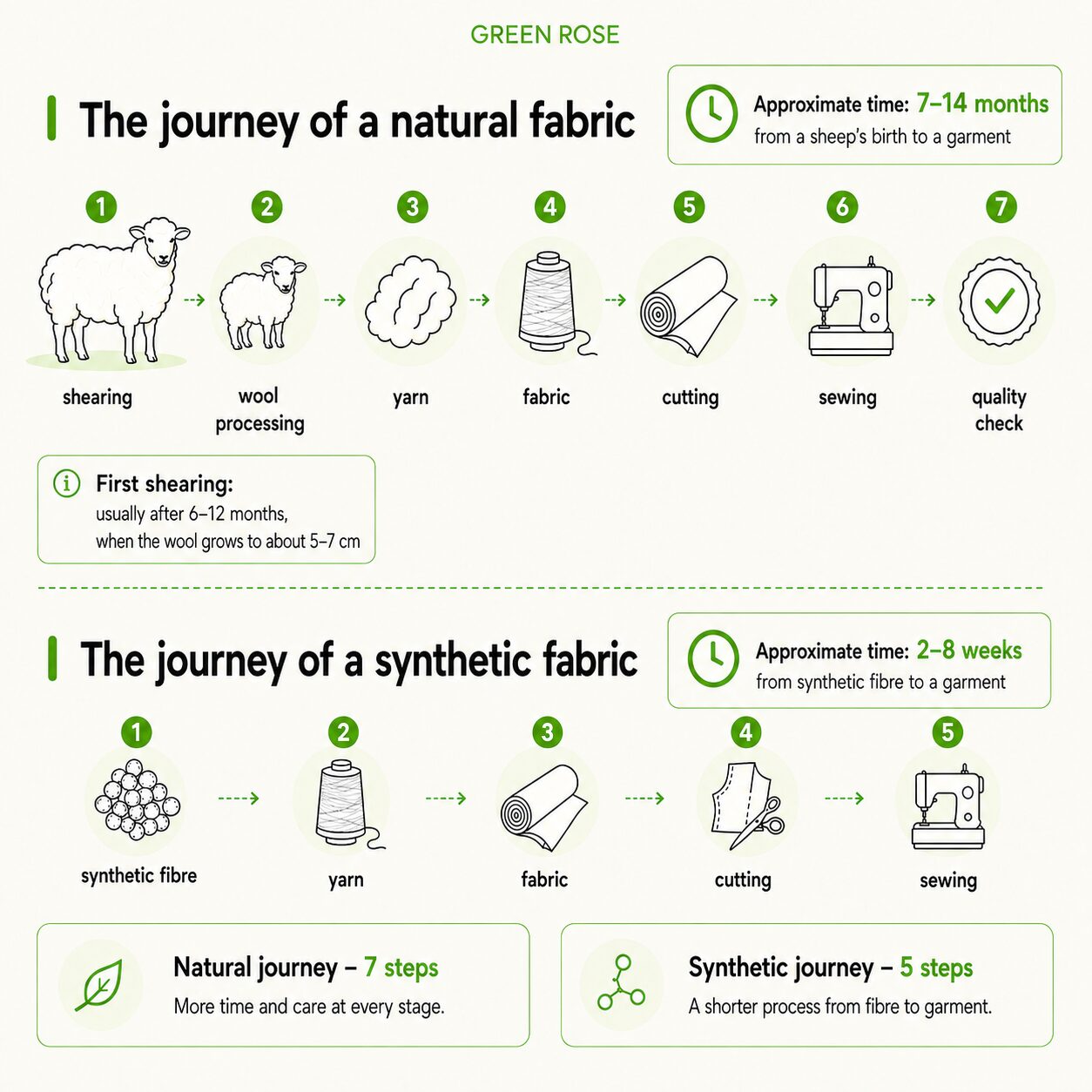
When clothes go into the laundry after one wear
The practical difference becomes especially noticeable with children.
An active child runs, gets warm, sweats, cools down and starts moving again. A cotton top can quickly absorb moisture and odour, which often means it goes straight into the laundry basket.
In some families, two good merino base layers are enough to rotate between wears, while more ordinary tops would be needed to cover the same period.
Of course, merino cannot prevent food stains, paint, mud or everything else children bring home. But when it comes to sweat, odour and temperature changes, it often proves its value by requiring less care after each wear.
What does one wear actually cost?
We usually compare clothes by looking only at their purchase prices: one T-shirt costs less, another costs more.
Measured this way, merino wool can certainly seem expensive. A more useful question is:
How many times will I wear it?
A merino top, thermal shirt or children’s base layer that is worn regularly, aired between uses, washed less often and kept in good condition spreads its cost across many wears. For example:
A men’s merino wool T-shirt costs €39. If it is worn for around 90 days in one season, the cost is approximately €0.43 per day.
If it is worn for two seasons, the cost falls to around €0.22 per day. By the third season, it is approximately €0.14 per day.
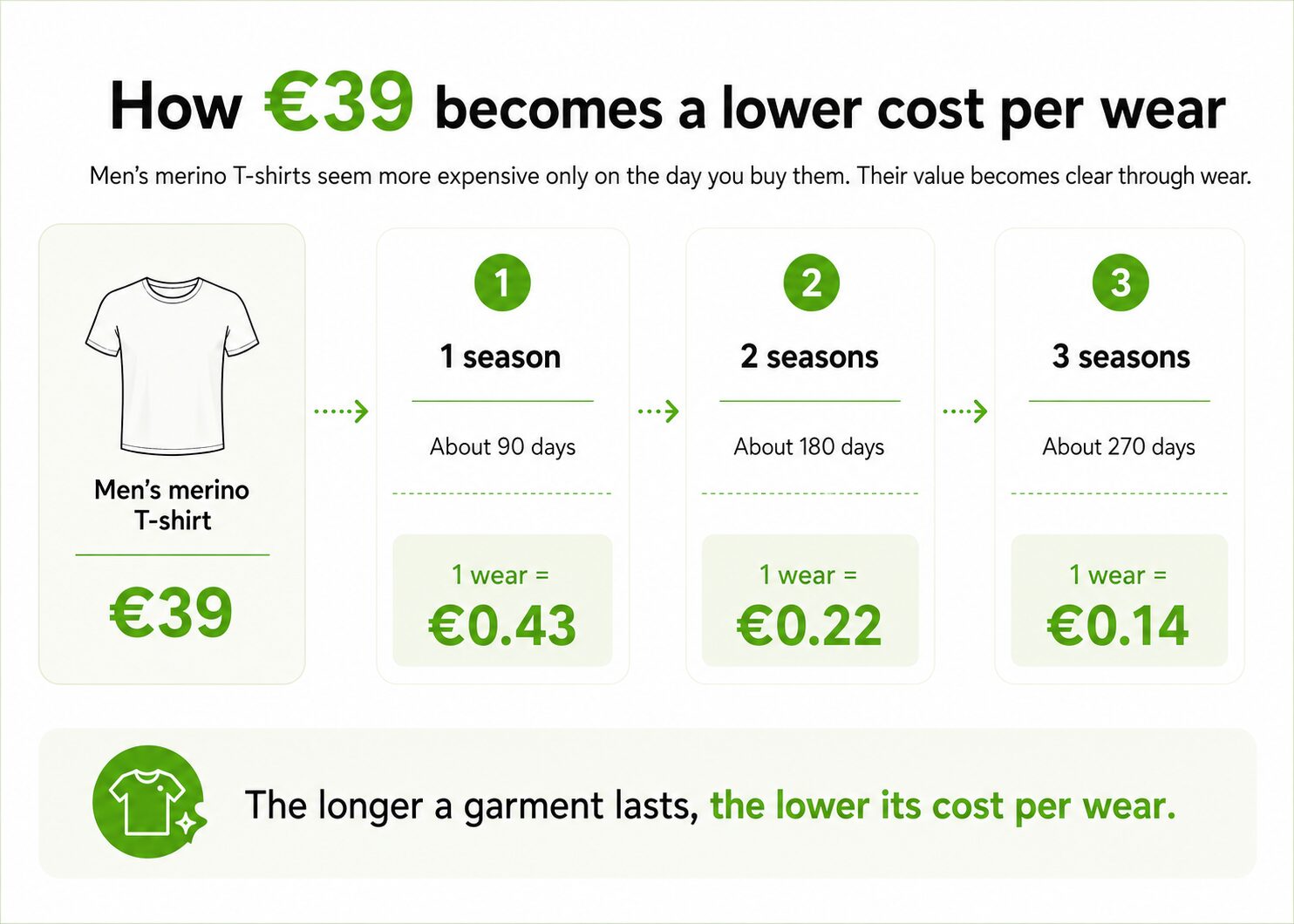
That is why the purchase price alone does not tell the whole story. The more often a garment is worn, the lower its cost per wear becomes.
Why can synthetic or cotton clothing cost just as much?
This is something that surprises customers — and sometimes us too.
Shops often sell synthetic, cotton or blended sweatshirts at prices similar to those of well-made merino wool garments.
So what are we paying for?
Sometimes it is the brand name. Sometimes it is the design, a marketing campaign, a seasonal trend or a discount that makes the original price appear more attractive. The fibre itself is not always the most expensive part of the garment.
This is why it is worth looking beyond the label. Consider the composition, how often the item will be worn, whether it will retain its shape and whether it may still be useful next year.
With children’s clothing, there is another question: will it remain in good enough condition to be passed on to a younger sibling, relative or friend?
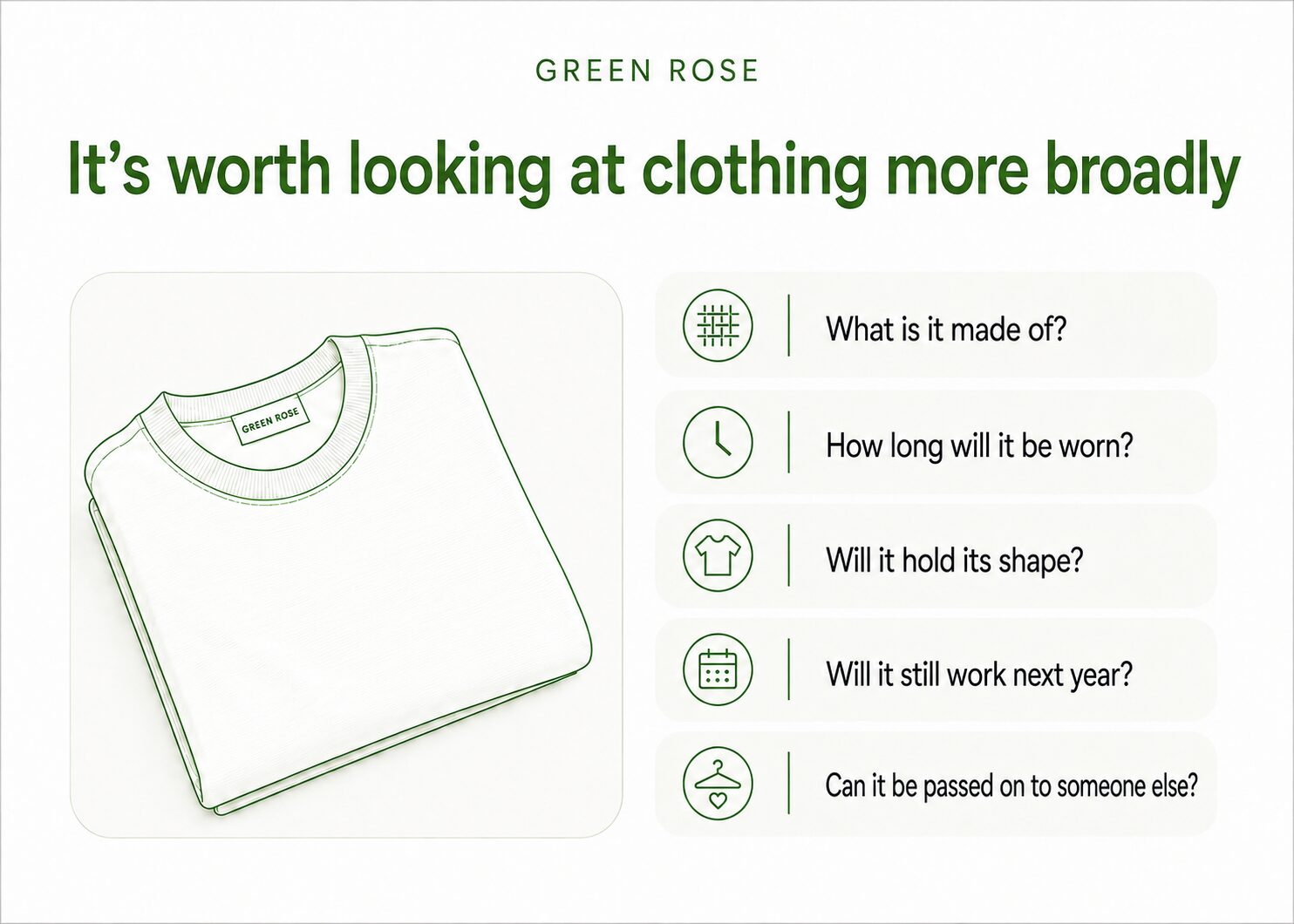
What are we paying for when we choose merino?
A natural fibre that responds to the body
Merino wool is sometimes described as a “living” fibre. A more accurate way to put it is that it is an active natural fibre that responds to body heat and moisture.
In cooler conditions, merino helps the body retain warmth. As the body gets warmer, the fibre helps manage moisture and is less likely to hold unpleasant odours. These properties are particularly useful in base layers, children’s clothing, sleepwear, travel clothing and garments worn during outdoor activities.
The value is not limited to the garment itself. It may also mean fewer changes of clothes, less washing and fewer spare layers to carry.
Warmth without a wardrobe full of extra layers
Extra clothing is another cost we rarely calculate.
When a base layer becomes damp quickly or does not provide enough warmth, we often compensate by adding another jumper, another thick garment or one more layer “just in case”.
A well-chosen merino layer helps retain warmth in cooler conditions while remaining comfortable when the body heats up. Instead of carrying or buying a large collection of backup clothes, a few practical merino layers may be enough.
This can be especially useful for children. A thinner layer that feels pleasant against the skin allows more freedom of movement and is often easier for a child to wear than a bulky, restrictive garment.
When might merino wool not be worth it?
Merino is not the perfect answer in every situation. If a garment will be worn only once a year, its value should be calculated differently.
Constant friction from backpack straps or rough outer layers can affect the fabric. Incorrect washing can also shorten the garment’s lifespan. And if a child returns home covered in food, paint or mud every day, regular washing will still be necessary. The word “merino” on a label is therefore not enough on its own. The garment should suit the way you and your family actually live.
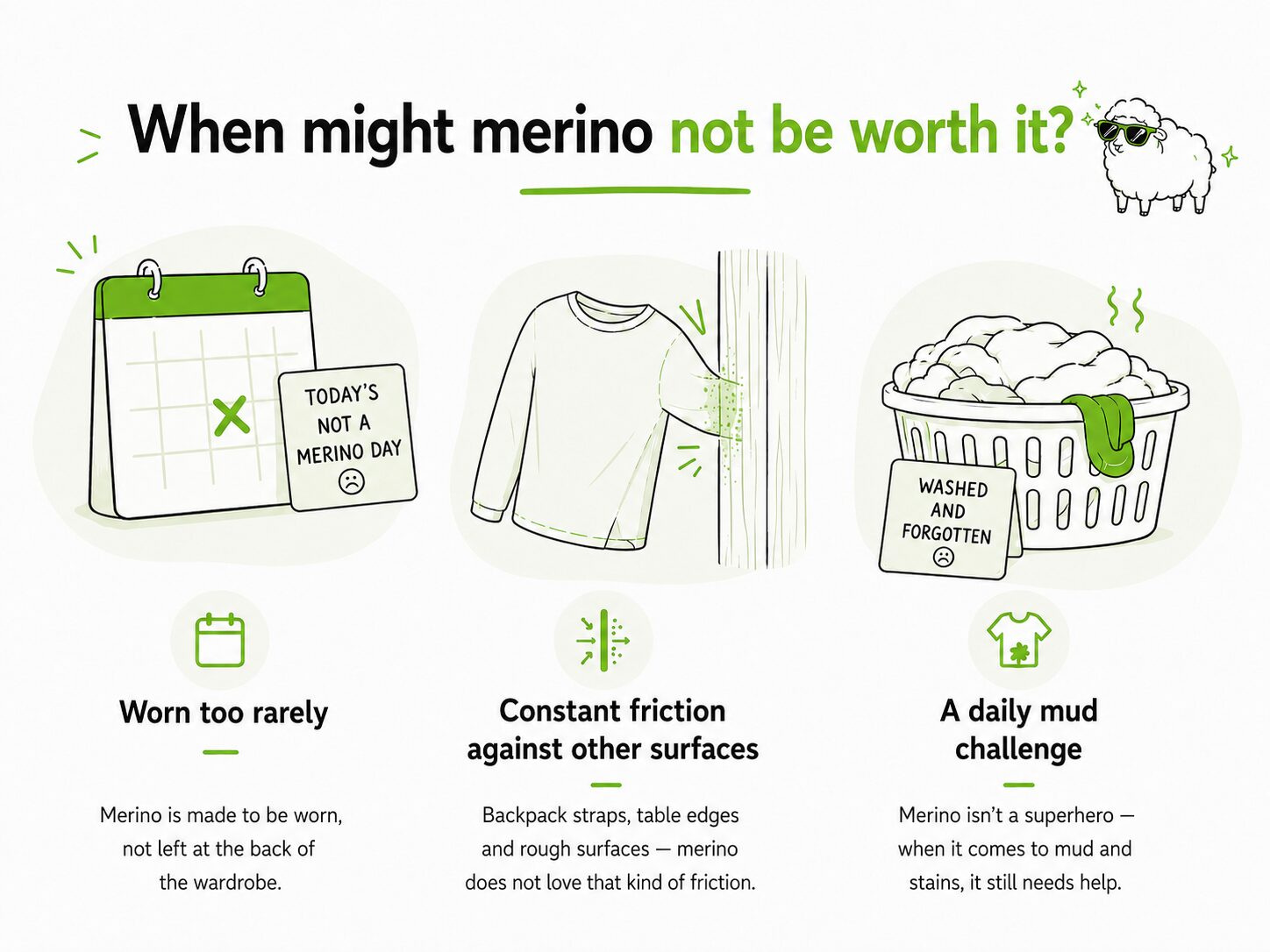
When merino wool clothing is chosen for situations in which its properties are genuinely useful, it often becomes a practical and considered purchase rather than a luxury.
Perhaps merino is not as expensive as it first appears
Let’s return to the man who said he would buy merino when he became rich.
Perhaps merino wool is not quite as expensive as it seems on the day of purchase. Its value simply does not sit entirely on the price tag. It becomes visible over time, through repeated wear.
The more often a garment is chosen, the clearer it becomes that the price covers more than fabric. It can also mean less washing, fewer spare clothes and fewer decisions about what to wear.
Start with one versatile merino layer
When one merino garment replaces several less practical alternatives, the original price begins to look different. For anyone who still sees merino as a big investment, the best place to start is with one versatile layer: a children’s top, a base-layer shirt, a pair of leggings or a thermal set.
Wear it regularly, air it between uses and notice how often it replaces other clothes.
Sometimes we spend less on the day of purchase, but only repeated wear shows whether we really chose the more affordable option.
And one question remains: did the man who left the shop without merino really save money?
Start with one versatile merino layer your family will genuinely wear
-

Men’s short sleeve shirts in merino wool
Price range: 39,00€ through 48,00€ -
Women’s Merino T-Shirt
Price range: 35,00€ through 39,00€ -
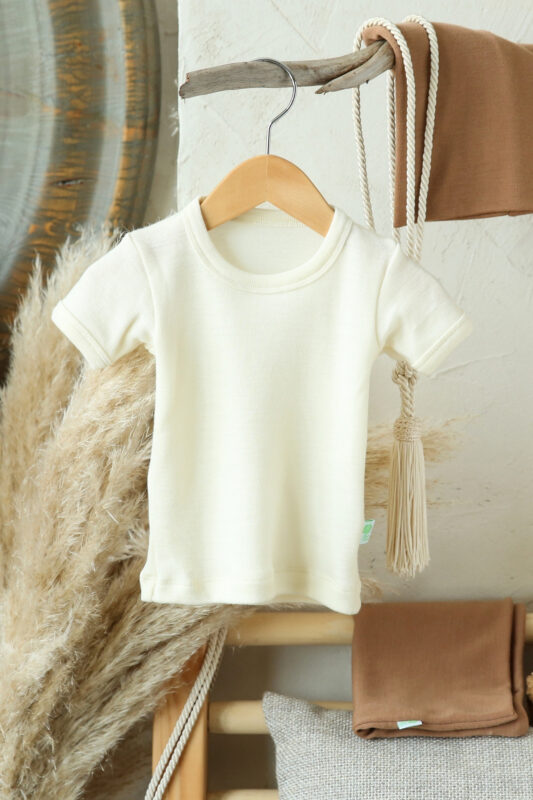
Merino Wool and Silk White Short Sleeve Shirt for Kids
Price range: 21,00€ through 33,00€ -
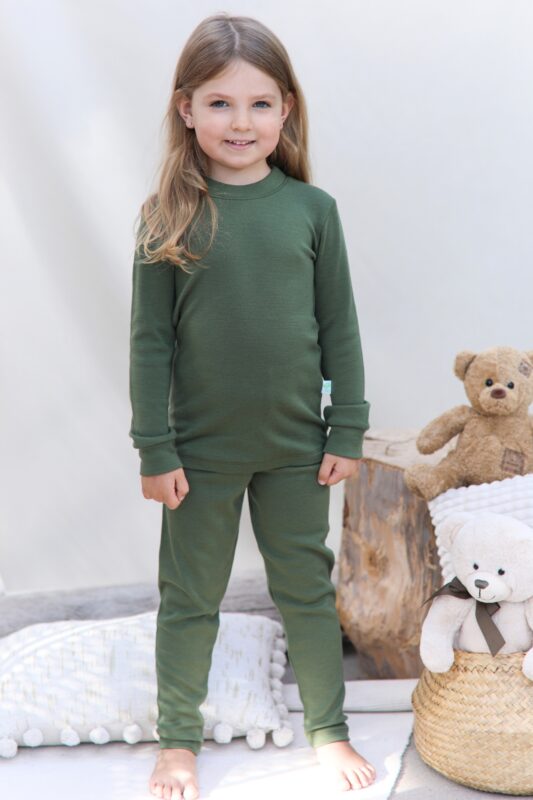
Merino Wool Kids Base Layer Set
51,00€ – 81,00€46,00€ – 76,00€